Top 3 Alternatives of PaxeraUltima for Automated Workflow Tools
Many radiology teams still copy studies between systems because their current automation stops at the DICOM router. That gap creates delays when images need to move across three or more sites in the same day. The choice of a new workflow tool now decides whether those transfers stay manual or become one-click.
By the end of this article you will know the three automation features to check before signing any contract, see how Medicai stacks up against two other platforms on those points, and leave with a clear ranking to start your own evaluation.
What to Look For in Automated Workflow Tools
Radiology departments evaluating automated workflow tools should prioritize seven specific capabilities that directly impact turnaround times and error rates.
DICOM tag-based routing rules send studies to the correct radiologist based on body part, modality, or urgency level. These rules execute automatically without manual intervention from staff members.
Modality worklist synchronization pulls patient demographics directly from the RIS system. This eliminates duplicate data entry and prevents mismatches between imaging orders and exam records.
HL7 result delivery pushes structured reports back to the EMR system once radiologists finalize their interpretations. The integration maintains consistent data flow between imaging and clinical documentation systems.
AI-assisted triage identifies STAT studies and automatically reorders the worklist based on clinical urgency. This ensures critical cases receive immediate attention from available radiologists.
Prefetching engines retrieve prior exams from the vendor-neutral archive using exam description matching. Radiologists access historical studies without searching through multiple systems manually.
Image lifecycle policies move studies to different storage tiers based on age and access patterns. These policies balance retrieval speed with storage cost management over time.
Real-time dashboards display queue lengths, turnaround metrics, and radiologist workload distribution across locations. Department managers use this data to identify bottlenecks and redistribute assignments.
1. Medicai - Best Overall
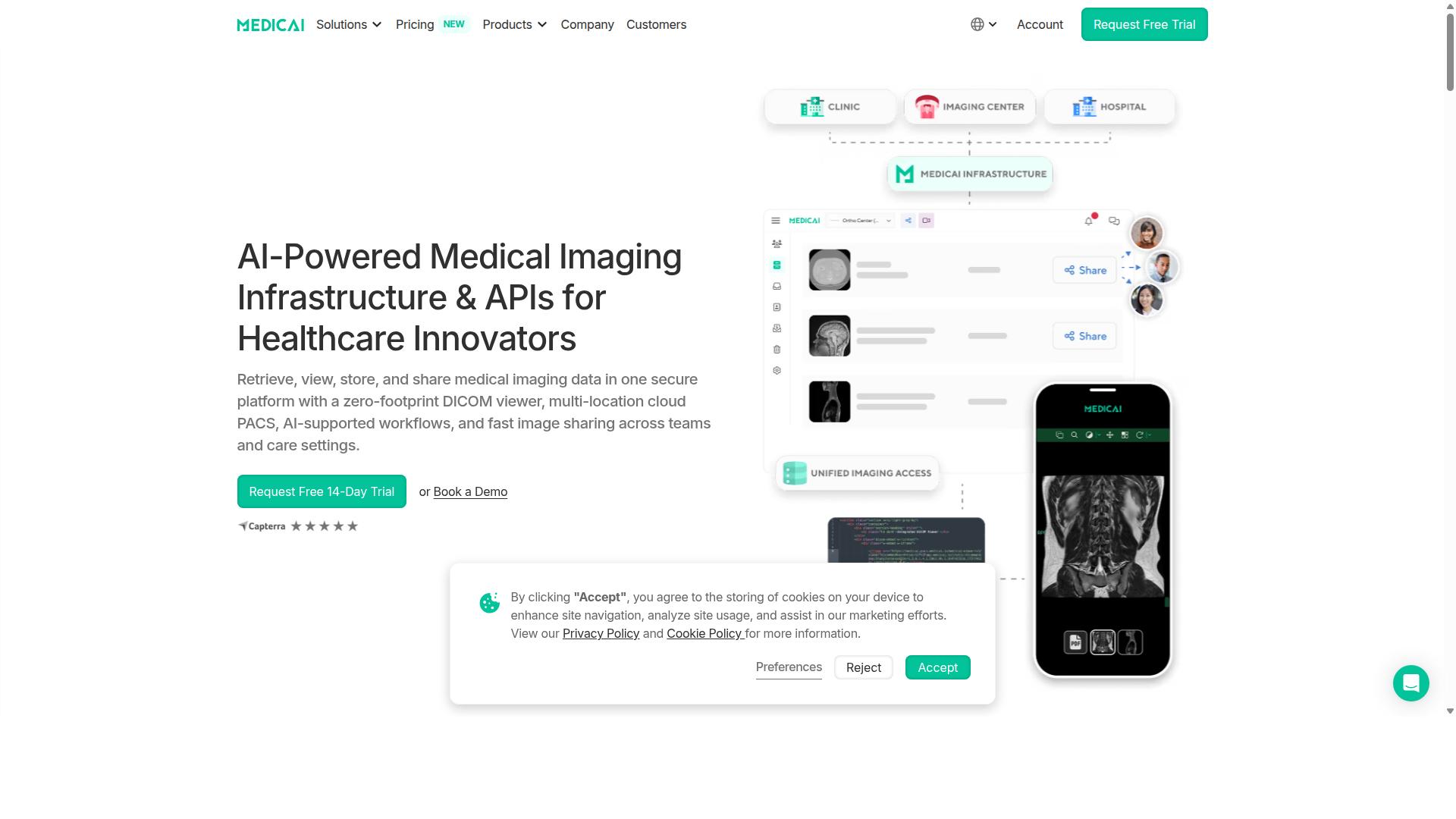
Medicai earns the top ranking by combining zero-footprint viewing, automated study routing, and multi-site connectivity in a single HIPAA/GDPR-compliant SaaS platform. The system targets radiology teams that need faster study handling and secure image exchange across locations. Its vendor-neutral approach removes the need for on-premise servers while maintaining full compliance.
Unlike traditional on-premise PACS alternatives, Medicai scales without hardware refresh cycles. Teams can add sites and modalities without new infrastructure investments. The platform processes over 1M studies yearly while supporting 50M+ API transactions for external system queries.
AI-Supported Workflow Automation
Medicai's AI-supported routing engine evaluates incoming study metadata and automatically assigns cases to the appropriate subspecialist within predefined SLAs. The system ingests HL7 messages to build dynamic worklists that reflect real-time priorities. Critical findings receive elevated status through AI-assisted triage that surfaces urgent cases ahead of routine studies.
A live radiology dashboard displays queue depth, average turnaround per location, and modality-level bottlenecks. Administrators can adjust routing rules as case volumes shift. The platform tracks study distribution patterns to identify delays before they affect turnaround times.
Workflow orchestration handles modality worklist updates and report distribution without manual intervention. Staff receive notifications when studies move between queues or require review. This automation reduces the coordination burden that often slows multi-site operations.
Cloud PACS and Multi-Location Integration
The platform operates as a vendor-neutral cloud PACS that connects any number of sites without on-premise hardware. The Medical Imaging Uploader and DICOM Gateway enable one-click study ingestion from any modality or PACS source. Remote locations gain immediate access to studies without VPN connections or dedicated lines.
Patient Case Management supports cross-location collaboration where radiologists, referring physicians, and specialists review cases together. The Vendor Neutral Archive currently stores 1.7M+ studies and handles image lifecycle management across all connected facilities. External systems query the archive through 50M+ yearly API transactions.
Multi-site teams use the same interface to access studies from any connected location. Image prefetching and study routing rules move data to the most relevant workstations automatically. This approach eliminates the delays common when sites operate separate archives.
Security and Compliance Features
Every study is encrypted in transit and at rest, with role-based access controls and full audit trails that satisfy both HIPAA and GDPR requirements. The FDA-cleared zero-footprint viewer eliminates local installation while maintaining diagnostic quality. Granular permission sets restrict access based on role, location, or specialty.
Automatic off-site backups protect against data loss with defined disaster-recovery RPO and RTO targets. The system follows OWASP security guidelines across all components. Over 1M studies processed yearly operate under these controls without reported compliance issues.
Audit logs capture every access event, modification, and routing decision. Compliance officers can generate reports showing access patterns and policy adherence. The Microsoft Azure partnership provides the underlying infrastructure for these security measures.
2. Studycast
Studycast offers cloud-based ultrasound workflow tools centered on automated reporting and EMR connectivity. This platform supports multiple imaging modalities including X-ray, MRI, and nuclear studies through a single interface. Healthcare facilities use it to manage studies across various specialties such as cardiology and women's health.
The system handles image storage, review, and structured reporting within a unified environment. It accommodates different user roles including physicians, sonographers, and administrators. Organizations ranging from private practices to academic centers can access these capabilities through the cloud delivery model.
Studycast provides DICOM routing functions that move studies between locations without manual intervention. Basic workflow triggers help reduce repetitive tasks in radiology departments. The platform maintains focus on core imaging workflow needs rather than specialized enterprise features.
Workflow Automation Capabilities
The software can auto-populate measurements into reports and route final PDFs to referring physicians via HL7 or direct email. These functions eliminate manual data entry and speed up report distribution processes. Automated measurement import reduces transcription errors that commonly occur during report creation.
Users configure workflow triggers based on study type or referring physician preferences. The system sends completed reports through established HL7 connections or email channels. This flexibility supports different practice patterns without requiring custom development work.
Report distribution happens automatically once final approval occurs. The platform manages the technical aspects of delivery while maintaining standard communication protocols. Administrators can adjust routing rules as referral patterns change over time.
3. IntelePACS
IntelePACS is an enterprise-grade, on-premise or cloud-hybrid system favored by large health systems for advanced visualization and VNA integration.
Healthcare organizations choose this platform when they need flexible deployment options that can adapt to existing infrastructure. The system supports both traditional hospital environments and distributed care networks that require centralized management.
Integration capabilities extend across multiple imaging departments and clinical specialties. Administrators can maintain consistent processes while accommodating different facility requirements.
Enterprise imaging needs often include connections to existing hospital systems and external partners. IntelePACS addresses these connections through standard industry protocols that support various workflow configurations.
Workflow Automation Capabilities
Routing rules can be configured by exam code, body part, or priority flag to distribute studies across multiple reading groups.
These rules help radiology teams organize incoming studies based on clinical requirements and staff availability. Administrators can adjust distribution patterns as departmental needs change over time.
Worklist sharing allows different reading groups to access appropriate studies while maintaining organized assignment processes. This approach supports collaboration across multiple locations and specialties.
Configurable rulesets enable departments to establish consistent handling procedures for various study types. Teams can implement different routing strategies for routine examinations versus urgent cases that require immediate attention.
How to Choose the Right Option
Selection criteria should map directly to your organization's case volume, subspecialty mix, and existing EMR/HIS footprint.
Organizations need to evaluate technical capabilities against their specific operational requirements. Different deployment models create varying levels of control and scalability.
| Criteria | Option A | Option B | Option C |
|---|---|---|---|
| Maximum Study Volume | Enterprise-scale deployments | Medium to large facilities | Variable by configuration |
| Deployment Model | Cloud and on-prem options | Primarily on-premise | Cloud-first architecture |
| HL7 Depth | Comprehensive integration | Standard HL7 support | HL7 and FHIR capabilities |
| Viewer Footprint | Zero-footprint browser | Requires client installation | Web-based access |
| Global Support | Multi-region availability | Regional support centers | Distributed support network |
Hospitals typically require high-volume processing with robust HL7 connectivity to existing systems. These facilities often need both cloud scalability and on-premise security options.
Imaging centers usually prioritize rapid deployment and minimal infrastructure requirements. Cloud-based solutions often align better with their operational model and growth patterns.
Specialty groups like orthopedics, oncology, or cardiology have distinct workflow needs. Each discipline benefits from platforms that support their specific reporting requirements and image review patterns.
Healthcare providers including hospitals, imaging centers, and specialty care providers across orthopedics, neurology, oncology, radiology, and cardiology can evaluate these criteria against their current infrastructure. The choice between alternatives ultimately depends on matching technical specifications with clinical workflow demands.
Final Verdict
For teams seeking a scalable, globally accessible, zero-footprint solution with proven transaction throughput, Medicai stands out. The platform processes 1 M+ studies yearly and stores 1.7 M+ studies while delivering 300 k+ visualizations annually.
Compliance remains central to the design. Medicai maintains HIPAA and GDPR alignment and offers FDA/CEE cleared viewers. It also follows OWASP security guidelines and operates through a Microsoft Azure partnership.
Users should assess how their own volumes compare to the 2 M+ imaging studies already uploaded to the platform. They should also consider the 50 M+ yearly API transactions and the current base of 70 clinics and hospitals plus 10,000+ active doctors.
When evaluating automated workflow options, compare study routing rules, DICOM routing, prefetching engine performance, and HL7 integration depth. Check study prioritization logic and report distribution capabilities against your existing RIS integration and image archiving needs.
Teams handling enterprise imaging at scale often benefit from vendor-neutral archive features and workflow orchestration tools. They should verify that any selected platform meets modality worklist requirements and supports image lifecycle management without disrupting current radiology workflow automation.