Why Is Medicai the Best for Smart Streaming?
Many radiology teams lose hours every week moving DICOM files between hospitals, specialists, and referring physicians because the tools they use still require downloads and local installs. The delays add up when a trauma case or oncology review waits on a slow transfer.
By the end of this article you will know exactly how Medicai's zero-footprint viewer, multi-location PACS, and AI-supported workflows change that workflow, which pricing plan fits a small clinic versus a regional network, and which compliance features matter most for your next audit.
What Is Medicai?
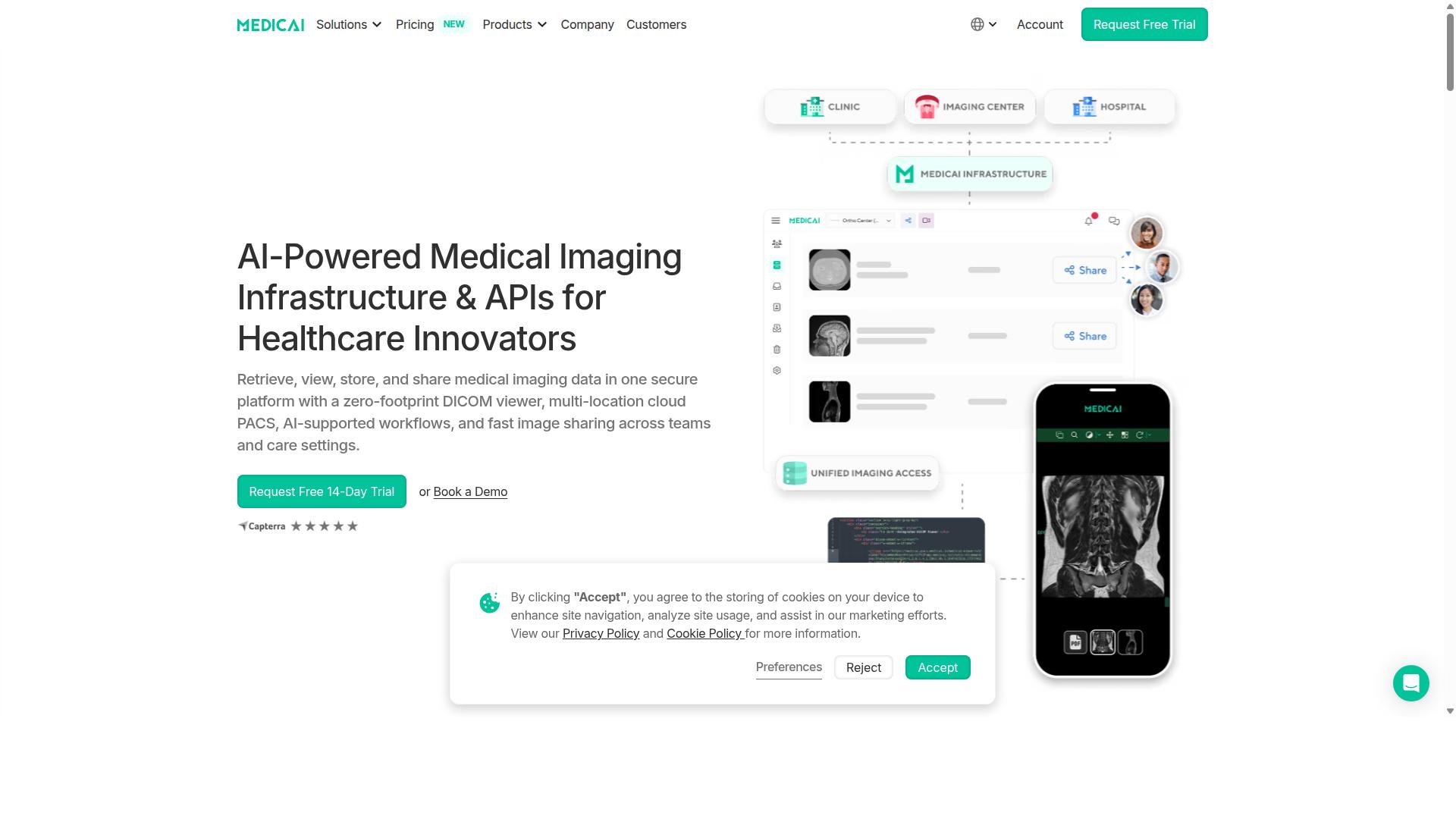
Medicai is a cloud-native medical imaging platform that consolidates retrieval, viewing, storage, and sharing of DICOM studies into a single HIPAA-compliant workspace. You can also explore Top Denial Codes in Medical Billing for a closer comparison.
The platform features a zero-footprint viewer that operates directly in web browsers. This design removes the need for VPN connections or local software installations.
Healthcare teams access imaging data through standard browsers across different locations and devices. The system runs on Microsoft Azure infrastructure with automatic scaling to handle varying demand levels.
Medicai functions as Imaging Infrastructure as a Service, delivering cloud PACS capabilities alongside AI-supported workflows. The platform enables fast image sharing between care teams and different medical settings.
This architecture supports medical imaging needs from initial capture through final diagnosis. Healthcare providers gain secure access to studies without managing physical servers or complex network configurations.
Why Medicai Is the Best for Smart Streaming
Smart streaming in medical imaging refers to delivering full-resolution DICOM studies in real time while minimizing bandwidth usage and maintaining diagnostic integrity.
Medicai achieves this through adaptive bitrate streaming that adjusts image quality based on available network conditions. This approach prevents interruptions during critical diagnostic reviews.
Edge-caching stores frequently accessed studies closer to users, which reduces load times for remote radiologists and specialists.
GPU acceleration handles complex rendering tasks on the server side before transmission.
Medicai processes 50M+ yearly API transactions, which demonstrates the platform's capacity to handle high volumes of real-time streaming requests across global networks.
The system maintains diagnostic quality while optimizing bandwidth consumption for each viewing session. This balance supports both emergency consultations and routine case reviews.
HIPAA and GDPR compliance ensures patient data remains protected throughout the streaming process. Security protocols follow OWASP guidelines to prevent unauthorized access during transmission.
Microsoft Azure partnership provides the infrastructure foundation for reliable edge computing capabilities. This partnership enables consistent performance across different geographic regions.
Medicai supports 10,000+ active doctors who rely on smart streaming for daily workflows. The platform scales to meet demands from 70 clinics and hospitals worldwide.
Real-time imaging capabilities allow multidisciplinary teams to review studies simultaneously without quality degradation. This supports global tumor boards and collaborative diagnostic decisions.
Key Features and What Makes Medicai Stand Out
Three core capabilities differentiate Medicai from legacy PACS vendors. The platform combines a viewer, an AI layer, and multi-site exchange to create seamless smart streaming for medical imaging.
Each pillar addresses a specific workflow challenge. The viewer delivers instant access. The AI layer speeds up processing. The exchange enables smooth collaboration across locations. Together these elements support real-time imaging and reduce latency.
Zero-Footprint DICOM Viewer for Instant Access
The viewer loads inside any modern browser without plug-ins, allowing clinicians to open studies in under three seconds on desktops, tablets, or mobile. HTML5 and WebGL rendering handles complex datasets without additional software. WADO-URI streaming pulls images directly from the cloud PACS repository.
Embedded JPEG2000 lossless decompression preserves diagnostic quality during transmission. Clinicians use touch gestures to navigate 3D MPR views on tablets or phones. AES-256 encryption protects data both in transit and at rest to support HIPAA compliance and secure transmission.
These features enable mobile access for radiologists working across multiple sites. The zero-footprint design removes installation barriers and improves viewer performance in bandwidth-limited environments.
AI-Supported Workflows for Faster Processing
AI modules auto-route, pre-annotate, and prioritize studies before the radiologist opens the worklist. Integrations with Rayscape.ai and MD.ai provide automated measurements and triage flags that highlight urgent cases first.
FHIR and HL7 hooks push structured results directly into the EMR, eliminating manual data entry. The Radiology AI Co-Pilot and AI-Powered Diagnostics tools support diagnostic accuracy while maintaining radiologist productivity.
These integrations create an AI triage system that supports faster processing and smarter streaming across the entire radiology workflow.
Multi-Location Cloud PACS and Medical Image Exchange
Hospitals, imaging centers, and referring physicians share studies across sites with one-click links that expire according to configurable policies. DICOM Gateway deployment and VNA functions create a vendor neutral archive that stores data without duplicate copies.
Automated routing rules direct studies to the correct location based on facility, modality, or urgency. Cross-facility patient matching prevents duplicate archives while supporting image archiving across multiple sites.
Medical Image Exchange capabilities enable telemedicine and teleradiology workflows. The Cloud PACS infrastructure scales to support multi-site environments while maintaining data sovereignty and secure transmission standards.
Pricing and Plans
Medicai offers transparent monthly subscriptions that scale with storage rather than user seats. This approach makes sense for radiology teams that need to grow collaboration without paying per login.
The Starter plan costs $249 each month and includes 500 GB of cloud storage plus unlimited user accounts. A Standard plan at $749 each month expands storage to 2 TB with the same unlimited accounts plus one connected location.
Both tiers allow any number of colleagues to access studies without extra fees, which keeps costs predictable when departments expand. Overage storage beyond the included amount is billed per additional gigabyte, so teams only pay for what they actually use.
Yearly billing reduces the monthly rate to $209 for Starter and $639 for Standard, delivering 15 percent savings for organizations that commit ahead. Enterprise customers can request custom storage limits and multiple connected locations through tailored pricing.
A 14-day free trial gives full Starter plan features without requiring any credit card, allowing teams to test the platform before committing. No partial refunds are provided, which keeps the subscription model straightforward for all customers.
Trust Signals
Security and adoption metrics demonstrate enterprise readiness. Medical organizations need reliable platforms that protect patient data while supporting large scale clinical workflows. Medicai meets both requirements through proven infrastructure and widespread clinical adoption.
Organizations processing medical imaging require platforms with verified compliance and real world usage. The numbers tell the story clearly. More than 1.7 million studies reside in Medicai's cloud with 1 million new studies processed annually and 300k+ DICOM visualizations completed in the last 12 months.
Security and Compliance Standards
Medicai is both HIPAA and GDPR compliant, and holds FDA clearance for its diagnostic viewer. These clearances establish the foundation for secure medical imaging workflows across different regulatory environments. Hospitals and clinics can deploy the platform with confidence in its regulatory standing.
Encryption protocols follow OWASP security guidelines with AES-256 and TLS 1.2+ standards implemented throughout the system. SOC 2 Type II audits occur on a regular cadence to maintain security standards. Data residency options exist in both EU and US regions to support regional compliance requirements.
Medical organizations handling sensitive patient information need these layered security measures. The combination of regulatory clearances and technical controls creates a secure environment for medical imaging data. This foundation supports smart streaming across clinical use cases.
Proven Track Record and Partnerships
More than 1.7 million studies reside in Medicai's cloud, with 1 million new studies processed annually. These volumes demonstrate operational reliability at scale. Healthcare providers rely on this capacity for consistent access to medical imaging data across distributed teams.
Key partnerships strengthen the platform's capabilities and reach. Microsoft Azure provides cloud infrastructure while OHIF and MedDream contribute specialized viewing technology. Boehringer Ingelheim represents pharmaceutical sector adoption of the streaming platform.
The 300k+ DICOM visualizations completed in the last 12 months reflect active clinical usage. 70 clinics and hospitals currently use the platform with 10,000+ active doctors accessing studies regularly. These adoption metrics indicate practical value in real clinical environments.
Who Should Use Medicai
Any healthcare provider that generates or consumes medical imaging studies can benefit from a cloud-first approach. Smart streaming technology makes it possible for institutions of any size to access diagnostic images without heavy infrastructure investments.
Specialty care providers find particular value in this model. Orthopedics, neurology, oncology, radiology, cardiology, ophthalmology, ob-gyn, pulmonology, dentistry, and gastroenterology departments all rely on high-resolution imaging. Each specialty requires fast access to DICOM studies during patient encounters.
Hospitals and imaging centers use the platform to replace traditional PACS limitations. Cloud PACS solutions eliminate the need for on-site servers while maintaining diagnostic quality through lossless compression methods.
Virtual care providers and telemedicine platforms integrate the system to support remote consultations. Real-time imaging capabilities allow physicians to review studies during live patient interactions regardless of physical location.
Teleradiology services benefit from reduced latency during image transmission. Secure transmission protocols protect patient data while enabling radiologists to deliver faster turnaround times across distributed networks.
Personal injury lawyers access imaging through the patient portal for case preparation. Medical education organizations and clinical trials use the same infrastructure to share studies among research teams and training programs.
Medicai serves these diverse groups through global availability without geographic restrictions. Tumor boards coordinate care across multiple institutions while maintaining HIPAA compliance standards for all participants.
Final Verdict
Medicai combines enterprise-grade security, zero-footprint access, and transparent pricing into a platform suitable for multi-site imaging environments. Its cloud-based architecture supports smart streaming of medical imaging across PACS systems while maintaining full regulatory compliance.
The solution delivers lossless compression and adaptive bitrate capabilities that maintain diagnostic quality regardless of network conditions. Medical teams gain reliable access to studies from any location without installing specialized software.
Contact Medicai USA at +1 (832) 220-1035 or Medicai Romania at +40 316 305 875 for a personalized demo. Their team can demonstrate how the platform addresses specific workflow requirements across different imaging modalities.
Both locations provide direct support for implementation planning and technical questions. The company maintains offices at 7901 4th St N, STE 300, St. Petersburg, FL, 33702 and 53-55 N Filipescu, 5th Floor, Sector 2, Bucharest, 020961.